
Education
2014.9-2019.6 Nanjing University of Information Science & Technology Meteorology Ph.D
2016.9-2018.9 Univerisity of Hawaii at Manoa, USA (Visiting Scholar)
2019.9-2021.7 Pohang University of Information Science and Technology, Postdoc
Work experience
2021.8-present Nanjing University of Information Science & Technology
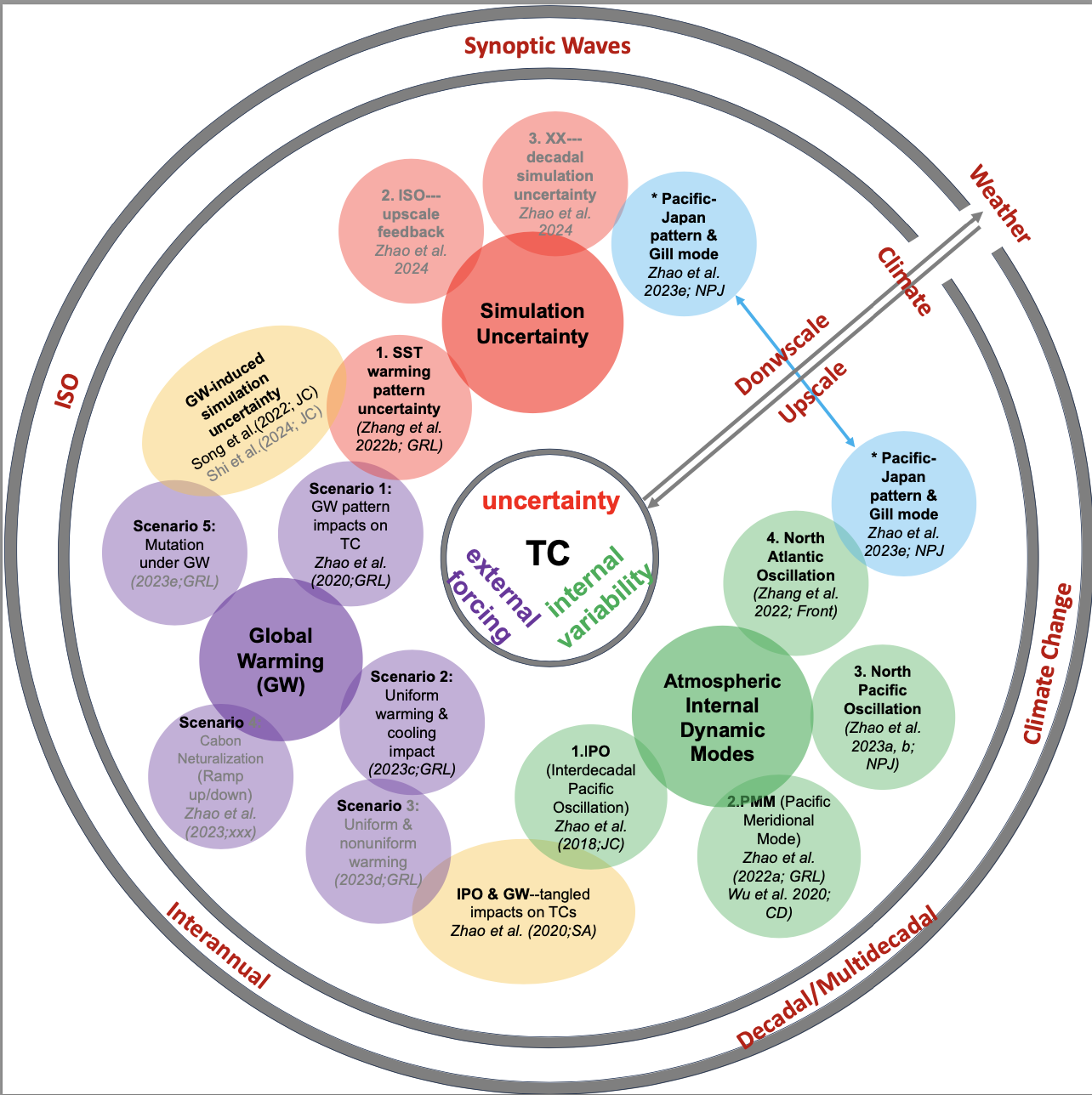
Research Map:
Research Interests:
A. Tropical Cyclone Climate Dynamics
Impacts of Internal Variability and External Forcing on TC Activity

Influence of IPO and global warming on TC variability (Zhao et al. 2018-JC; 2018-SR; 2020-SA)
Relative roles of IPO and AMO (Zhao et al. 2024-GRL; Song et al. 2022-JC)
PMM’s triggering of ENSO and its influence on WNP typhoons (Wu et al. 2020-CD; Zhao et al. 2020a-GRL)
NAO impacts on WNP typhoon activity (Wang et al. 2025-JC; Zhang et al. 2022-FES)
NPO as a precursor to ENSO (Zhao et al. 2023a,b-npj Clim. Atmos. Sci.)
TC Variability under Global Warming Scenarios

El Niño–like and La Niña–like warming patterns and their TC impacts (Zhao et al. 2020b-GRL; Zhang et al. 2022-GRL)
Uniform warming influences on TC activity (Zhao et al. 2023-GRL)
Relative contributions of uniform vs. non-uniform warming (Xu et al. 2024-ERL)
Ramp-up/ramp-down forcing effects (Liu et al. 2024-npj)
Projected TC changes under warming (Shi et al. 2023-GRL)
Sources of Uncertainty in TC Simulation
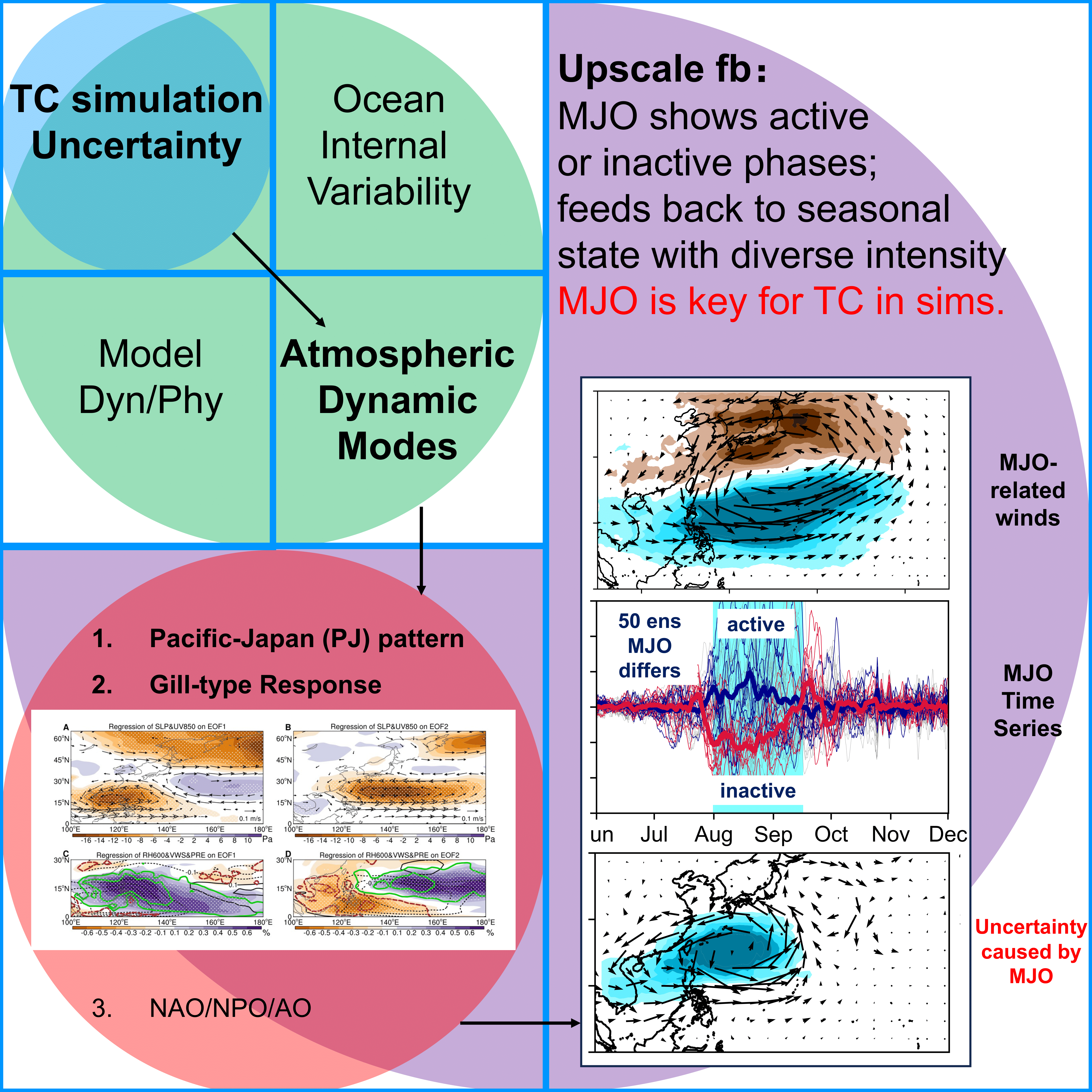
Role of IPO/AMO simulation uncertainty (Song et al. 2022-JC; Zhao et al. 2022-JGR)
Matsuno–Gill and Pacific–Japan modes in ENSO-year TC simulation bias (Zhao et al. 2023-npj)
MJO upscale feedback on TC simulation uncertainty (Zhan, Zhao et al. 2025-JC*)
Arctic Oscillation’s contribution to decadal TC simulation uncertainty (Li et al., in prep.)
Matsuno–Gill mode in warming-induced TC uncertainty (Shi et al., in prep.)
Tropical Volcanic Eruption (TVE) Impacts
Global TC response to historical TVEs (e.g., Pinatubo, Tambora) (submitted to ERL/GRL)
Comparative TC impacts of tropical vs. extratropical eruptions (in progress)
Seasonal Dependence of TC Activity
Seasonality in landfalling TCs over China (Wang, Zhao et al. 2025-GRL*)
Seasonal dependence of ENSO-year TC changes (Wang, Zhang & Zhao 2025-JGR*)
B.High Resolution Simulation:
6. Multi-scale simulation
7. Seasonal Prediction based on HIRAM and CESM
8. Simulation Uncertainty (/RegCM model)
a. Hindcast (HIRAM-C180)

Tropical cyclone genesis (left) and track (right) in current (upper) and warmer climates (bottom)
b. Ensemble simulation (RegCM-Yuqing Wang)
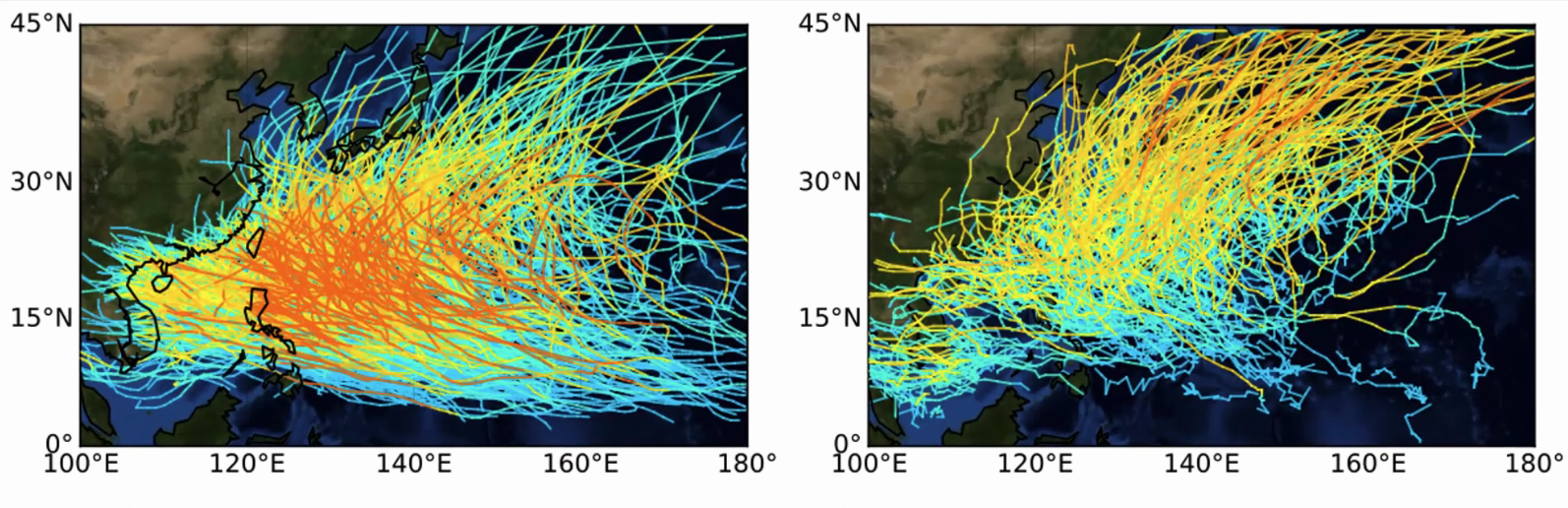
Observed and RegCM-simulated TC tracks from 1982-2021
c. Prediction: Genesis、Track & Intensity (HIRAM+Sintex)
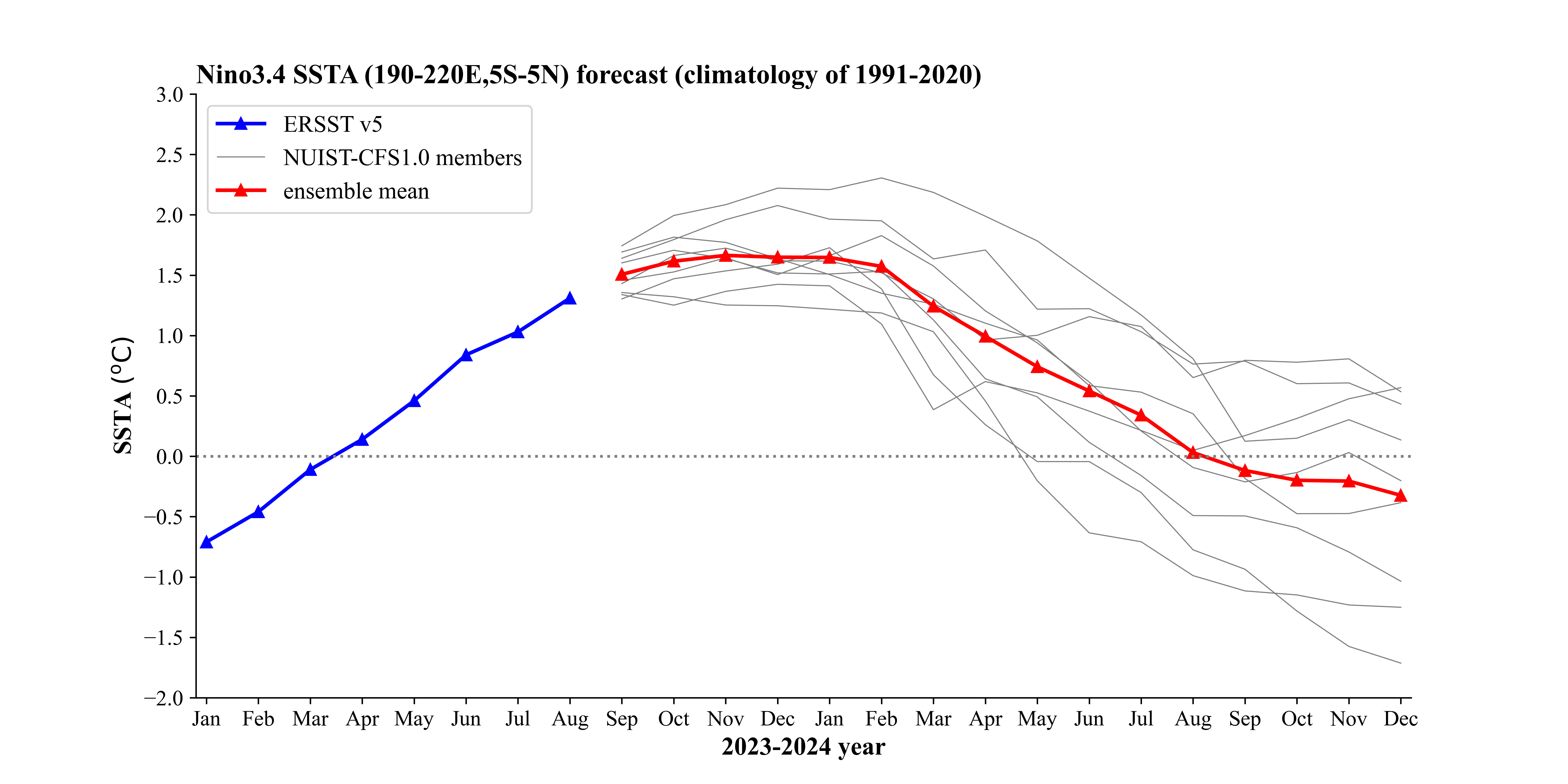
1. SST prediction from Aug 2023 to Dec 2024 (with the helps of Luqing Ma and Song Yang)
d. RI (WRF)
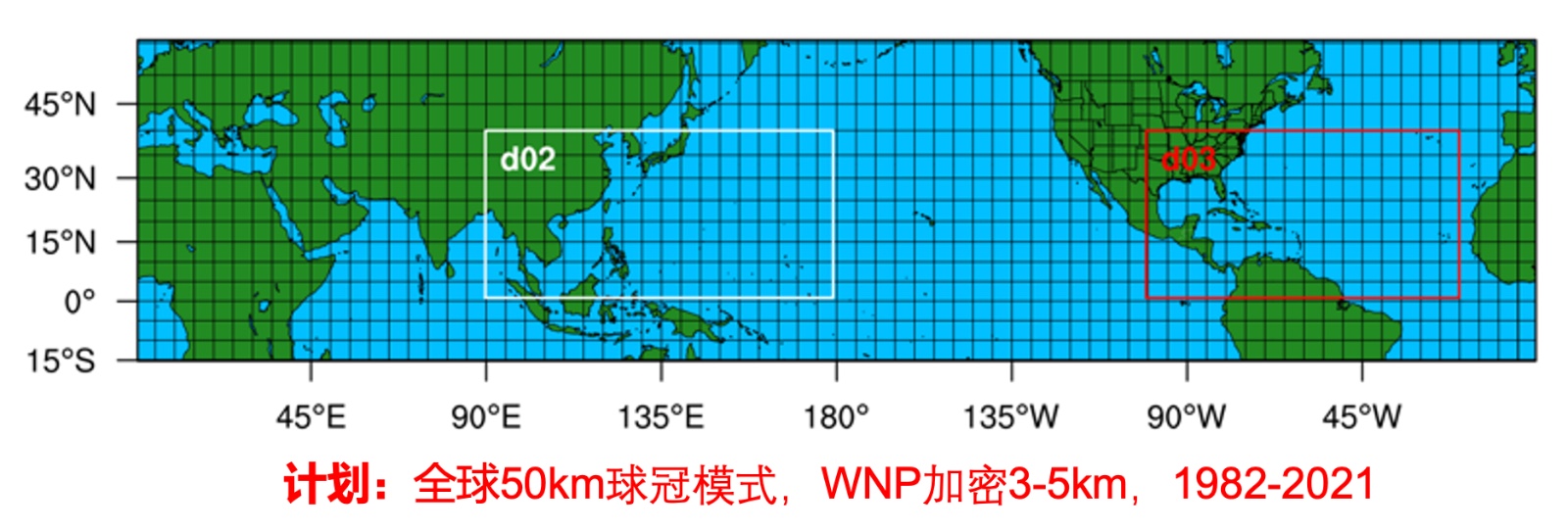
TC-resolved climate simulation based on WRF
e. LES (CM1-Bryan)

TC intensity and RMW in axisymmetric simulations
Selected publication (# co-first author,* co-corresponding author, Bule color : Representative papers):
–––––––––––––––––––––––––––––––––––––––––––––––––––––––––––––––––––––––––––––––––––––
2026年:
029. Song KX, Zhan* RF, Zhao* J, Wang YQ and Tao L. Seasonal advance of rapidly intensifying tropical cyclones in the Northwest Pacific. (Under Review)
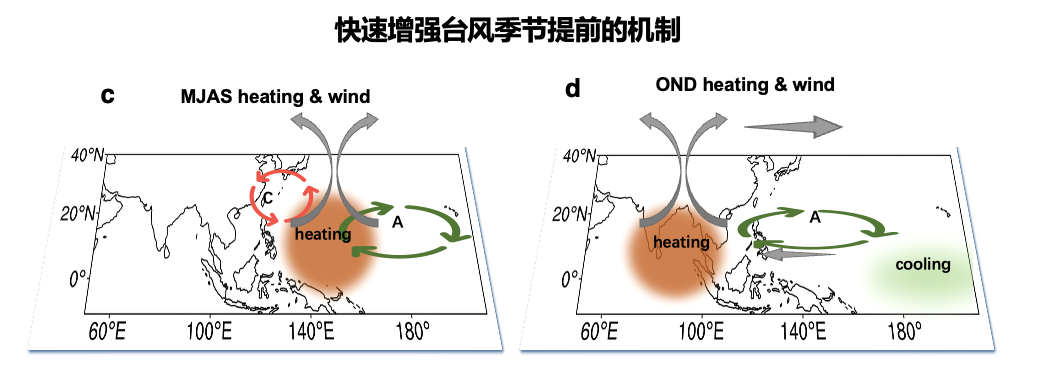
This study elucidates the physical mechanisms underlying the seasonal advance of rapid intensification (RI) processes of tropical cyclones (TCs) in the Northwest Pacific. RI exhibits a pronounced seasonal cycle and has traditionally been most frequent during August–October. However, our analysis reveals a significant shift toward earlier seasons in recent decades: RI events have become more frequent during May–September, accompanied by a marked reduction during October–December.
Further investigation shows that under global warming, enhanced local diabatic heating over the western North Pacific induces a pronounced Gill-type atmospheric response, favoring the earlier onset of RI during May–September. As the seasonal cycle progresses, the climatological warm SST belt retreats southward, and during autumn and winter (October–December), local heating over the western North Pacific no longer dominates. Instead, warming in the Indian Ocean exerts a suppressive remote influence on RI activity. Notably, these conclusions are robust and independent of El Niño–like or La Niña–like warming patterns.
028. Li JN, Zhang LY, Zhao* J and Song K. Simulation uncertainty of tropical cyclone genesis frequency during Interdecadal Pacific Oscillation modulated by the Arcticle Oscillation. (Submitted to JGR)
027. Wang WH, Zhao* J, Wang YQ, Hang RL and Yu RL. Simulation uncertainty of typhoon Faxai (2019) induced by subtropical high and monsoon trough in the Northwest Pacific. (Submitted to SCES)
026. Zhao J, Bai L, Zhan* R, Liu* Y, Cai W, Wang Y, Kug J-S, Moon I-J, Zhou B., Feng X, Ralf T, Zhang L., Chen H. Distinct impacts of Tropical North Atlantic warming flavors on cross-basin tropical cyclone geneses. (In Revision)
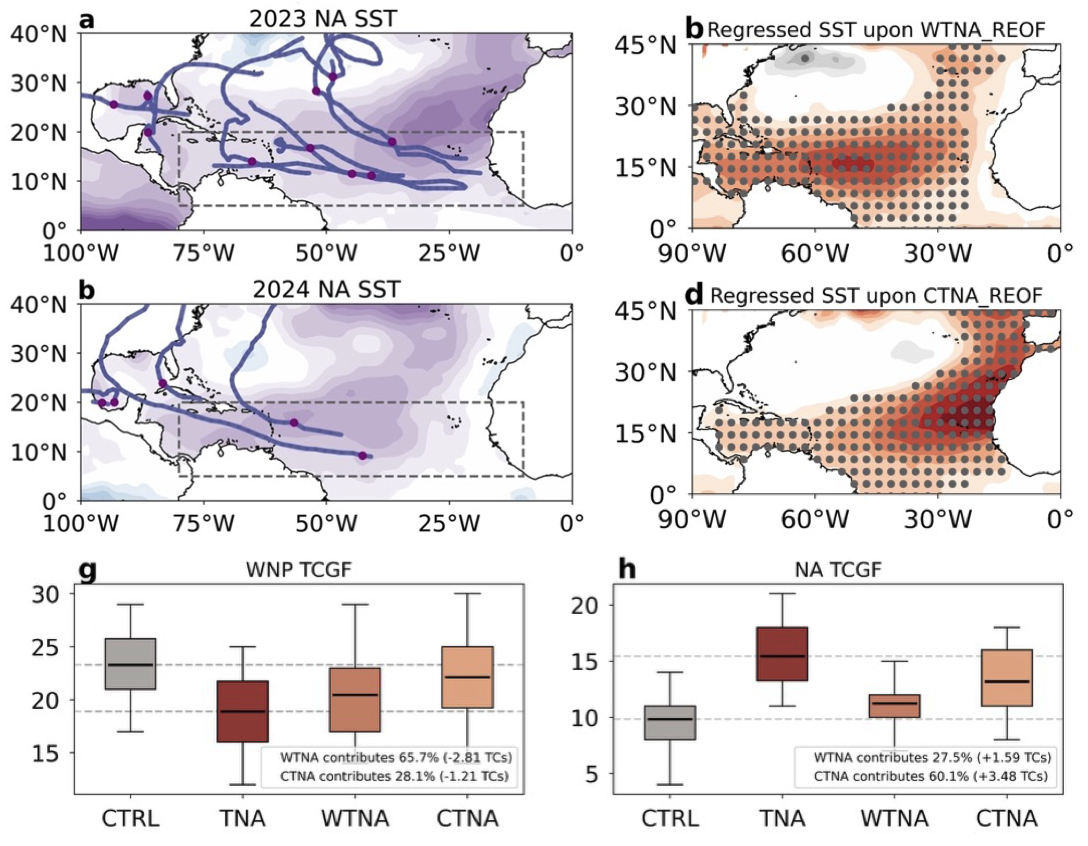
This study reveals the distinct impacts of two tropical North Atlantic (TNA) warming flavors on cross-basin tropical cyclone activity. During 2023 and 2024, the North Atlantic experienced unprecedented warming; however, TC activity differed markedly between the two years. In boreal summer (JJA) 2023, ten tropical cyclones formed—nearly double the climatological mean—despite the presence of a strong El Niño, which typically suppresses Atlantic TC formation. In contrast, only five tropical cyclones formed in 2024.
Observational analyses indicate that the warming patterns differed substantially: coastal TNA warming (CTNA) dominated in 2023, whereas warm-pool TNA warming (WTNA) prevailed in 2024. Using EOF analysis followed by a 45° rotation, we identify CTNA and WTNA as two distinct SST modes. We show that CTNA exerts a stronger influence on Atlantic TC activity primarily through local thermodynamic effects, whereas WTNA affects TC activity mainly through remote dynamical teleconnections, exerting a greater impact on tropical cyclone genesis in the Northwest Pacific.
2025年
025. Zhao J, Bai Luyao, Zhou* Botao, Zhang L. Contribution of decadal variabilities and global warming to the tornado occurrence in the United States of America. Atmospheric Research (2025g)
024. Shi Liang, Zhao* J, Zhan Ruifen. Tropical sea surface temperature biases inducing projection uncertianty in Northwest Pacific tropical cyclone genesis frequency during ENSO phase. Climate Dynamics (2025f)
023. Li Yue, Yang Y, Zhang L, Zhao* J, Liu S, and Wu K. Possible increase of tropical cyclone genesis frequency over the Northwest Pacific induced by the Tambora eruption in 1815. Weather and Climate Extremes (2025e)
022. Zhao* J, Zhan R, Li Y., Wang Y, Sun W, Feng X, and Liu S. Tropical volcanic eruptions increase global tropical cyclone genesis frequency. Environmental Research Letters (2025d)
021. Zhan Ruifen, Zhao* J, Wang Y, Kim D, Kug J, Liu C, and Gao Y. Contribution of intraseasonal variability to uncertainty in simulating seasonal activity of Northwest Pacific tropical cyclone as demonstrated using 1998. Journal of Climate (2025c)
020. Wang Fang, Zhao* J, Zhan* F, Yuan C, Feng X, and Tan Y. Seasonal contrast in the trends of landfalling tropical cyclone track density in China (1949-2023). Geophysical Research Letters (2025b)
019. Wang Fang, Zhang L, and Zhao* J. Distinct future changes and biases of tropical cyclone activities between fully-coupled and atmosphere-only models in the CMIP6-HighResMIP. Journal of Geophysical Research: Atmospheres (2025a)
2024年:
018. Zhao J, Zhan* R, Yuqing Wang, Shang-Ping Xie, L. Zhang and M. Xu. Lapsed El Niño impact on tropical cyclone genesis frequency over the Northwest Pacific and North Atlantic in 2023. Nature Communications (2024b)

Causes and Relative Contributions to the Climate extreme——Anomalous Tropical Cyclone Activity in 2023 over the Atlantic and Northwest Pacific
In typical El Niño developing years, tropical cyclone genesis frequency (TCGF) in the North Atlantic tends to be below average, while the Northwest Pacific (NWP) shows increased activity in the southeast quadrant and decreased activity in the northwest quadrant. However, 2023, ranked as one of the top five strongest El Niño years on record, exhibited contrasting behavior: 20 named storms formed in the North Atlantic during June–November—the third highest historically—whereas the NWP typhoon season recorded only 13 storms, the fewest on record. Our study found that the tropical North Atlantic (TNA) sea surface temperature (SST) reached its warmest levels on record, and the increased Atlantic TC frequency was driven jointly by this local warming and global warming (see Fig. e). Simultaneously, the North Pacific meridional mode (NPMM) exhibited its strongest negative phase on record. The combined effects of Atlantic warming, NPMM negative phase, and global warming led to the historic low typhoon frequency in the NWP (see Fig. f). This unprecedented conjunction likely allowed these factors to “override” the usual suppressive impact of El Niño on North Atlantic TC activity. This work was published in Nature Communications (August 2024) under the title "Lapsed El Niño impact on tropical cyclone genesis frequency over the Northwest Pacific and North Atlantic in 2023."
017. Zhao J, Zhan* R, Dae-Hyun Kim, Jong-Seong Kug, Long J, Zhang L and Ma X. Distinct Modulation of Atlantic Multidecal Oscillation and Interdecadal Pacific Oscillation on tropical cyclone precipitation over the western North Pacific, Geophysical Research Letters. (2024a)
2023年:
016. Shi Liang, Zhan* R., Zhao* J. and Jong-Seong Kug.: Mutating ENSO impact on Northwest Pacific tropical cyclones under global warming. Geophys. Res. Lett. (2023e).
015. Zhao, J., Zhan R., Hiroyuki Murakami, Yuqing Wang, Shang-ping Xie, Guo Y., Zhang L.: Atmospheric mode fiddling the simulated ENSO impact on tropical cyclone geneiss over the Northwest Pacific. npj Climate and Atmospheric Science. (2023d).
014. Zhao, J., F. Wang, R. Zhan, Y. Guo, X. Huang, and C. Liu: How Does Tropical Cyclone Genesis Frequency Respond to a Changing Climate? Geophys. Res. Lett., 50, e2023GL102879. (2023c)
013. Zhao, J, ——, ——, ——, and ——: Part II model support on a new mechanism for North Pacific Oscillation influence on ENSO. Npj Clim. Atmospheric Sci., 6, 16. (2023b)
012. Zhao, J., Mi-Kyung. Sung, J.-H. Park, J.-J. Luo, and Jong-Seong Kug, 2023a: Part I observational study on a new mechanism for North Pacific Oscillation influencing the tropics. Npj Clim. Atmospheric Sci., 6, 15. (2023a)
2022年:
011. Zhao J., Zhan*, R., Wang*, Y., Jiang L., & Huang X. A multiscale-model-based near-term prediction of tropical cyclone genesis frequency in the Northern Hemisphere. Journal of Geophysical Research: Atmospheres, 127, e2022JD037267 (2022c).
010. Song, Kexin, Zhao*, J., Zhan*, R., Tao. L., & Chen., L. Confidence and Uncertainty in simulating tropical cyclone long-term variability using HighResMIP. Journal of Climate, 35, 2829-2849 (2022b).
009. Zhang, Leying, X. Yang, and J. Zhao*: Impact of the spring North Atlantic Oscillation on the Northern Hemisphere tropical cyclone genesis frequency. Front. Earth Sci., 10, 829791 (2022a).
2021年:
008. Zhang#, Leying, Zhao#, J., Kug*, Jong-Seong, Geng, X., Xu*, H., Park, J.-H. & Zhan, R. Pacific warming pattern diversity modulated by Indo-Pacific sea surface temperature gradient. Geophysical Research Letters, e2021GL095516 (2021).
2020年:
007. Wu, Qiong, Zhao*, J., Zhan, R. & Gao, J. Revisiting interannual impact of the Pacific Meridional Mode on tropical cyclone genesis frequency in the western North Pacific. Climate Dynamics (2020).
006. Zhao, J., Kug*, Jong-Seong, An, Song-Il. & Park, J.-H. Diversity of North Pacific Meridional Mode and its distinct impact on El Niño and Southern Oscillation. Geophysical Research Letters, 47, e2020GL088993 (2020c).
005. Zhao, J., Zhan*, R. & Wang, Y. Different responses of tropical cyclone tracks over the western North Pacific and North Atlantic to two distinct sea surface temperature warming patterns. Geophysical Research Letters, 47, e2019GL086923 (2020b).
004. Zhao#, J., Zhan#, R., Wang*, Y., Xie, Shang-Ping. & Wu, Q. Untangling impacts of global warming and Interdecadal Pacific Oscillation on long-term variability of North Pacific tropical cyclone track density. Science Advances, 6, eaba6813 (2020a).

Quantifying the Relative Contributions of Global Warming and Internal Atmospheric Variability to Long-Term Changes in Tropical Cyclone Tracks
There remains considerable debate internationally regarding the dominant drivers of long-term tropical cyclone activity changes, with global warming effects on TCs still uncertain and internal climate variability further complicating the picture. Our previous work highlighted the significant role of the Interdecadal Pacific Oscillation (IPO) on decadal variability of Northwest Pacific TCs. However, the quantitative separation of contributions from internal variability (here focusing on IPO) and external forcing (global warming) to long-term TC track changes remains unclear.
Using a statistical approach to objectively separate external forcing from internal variability, combined with high-resolution typhoon climate model experiments, we elucidated the physical mechanisms and quantified the relative contributions of global warming (GW) and IPO to North Pacific TC track changes. Our findings identified these two dominant factors—GW-type warming and IPO decadal variability—as the primary drivers of long-term TC track density changes.
Specifically, IPO dominates the variability of TC track density over the Northwest Pacific: its positive phase enhances TC track density, while its negative phase suppresses it. GW, in contrast, generally acts to reduce TC track density in this region. Over the Northeast Pacific, IPO and GW have roughly equal influence, with both positive IPO phase and GW contributing to increased TC track density there (see figure). Published in Science Advances (October 2020) under the title "Untangling impacts of global warming and Interdecadal Pacific Oscillation on long-term variability of North Pacific tropical cyclone track density," this work has been cited over 60 times.
2019年以前:
003. Zhao, J., Zhan*, R. & Wang, Y. Global warming hiatus contributed to the increased occurrence of intense tropical cyclones in the coastal regions along East Asia. Scientific Reports, 8, 6023 (2018b; 引用超60次)
002. Zhao, J., Zhan*, R. & Wang, Y., and H. Xu : Contribution of Interdecadal Pacific Oscillation to the recent abrupt decrease in tropical cyclone genesis frequency over the western North Pacific since 1998. J Climate, (2018a)

New Mechanism Explaining the Recent Significant Decline in Northwest Pacific Tropical Cyclone Genesis Frequency
Since 1998, tropical cyclone genesis frequency (TCGF) over the Northwest Pacific has declined significantly, but the underlying causes remain uncertain. Prior studies suggested the Atlantic Multidecadal Oscillation (AMO) as a driver of this multidecadal decrease. Unlike previous work treating the entire Northwest Pacific TC population as homogeneous, we applied a K-means clustering method (see figure) to classify TCs by their tracks into three types:
Type 1: Long-track TCs mainly generated over the southeastern Northwest Pacific, predominantly strong storms.
Type 2: TCs generated north of 15ºN latitude.
Type 3: Nearshore TCs, with over 70% making landfall along the southeastern coast.
Our analysis shows that the recent significant decrease in Northwest Pacific TCGF is mainly attributable to a reduction in Type 1 long-track TCs, while Types 2 and 3 exhibited no significant decadal change (see figure). Further systematic analysis revealed that the negative phase of the IPO induces equatorial easterly anomalies, significantly suppressing tropical convection and thus inhibiting Type 1 TC genesis, explaining the decline since 1998.
This study was published in the Journal of Climate (October 2018) under the title "Contribution of the Interdecadal Pacific Oscillation to Recent Abrupt Decrease in Tropical Cyclone Genesis Frequency over the Western North Pacific since 1998," and has been cited over 100 times.
001. Zhao, J., Zhan*, R. & Wang, Y. and L. Tao, 2016: Intensified Interannual Relationship between Tropical Cyclone Genesis Frequency over the Northwest Pacific and the SST Gradient between the Southwest Pacific and the Western Pacific Warm Pool since the Mid-1970s. J. Clim., 29, 3811–3830, https://doi.org/10.1175/JCLI-D-15-0729.1.
No Content
No Content


 MOBILE Version